
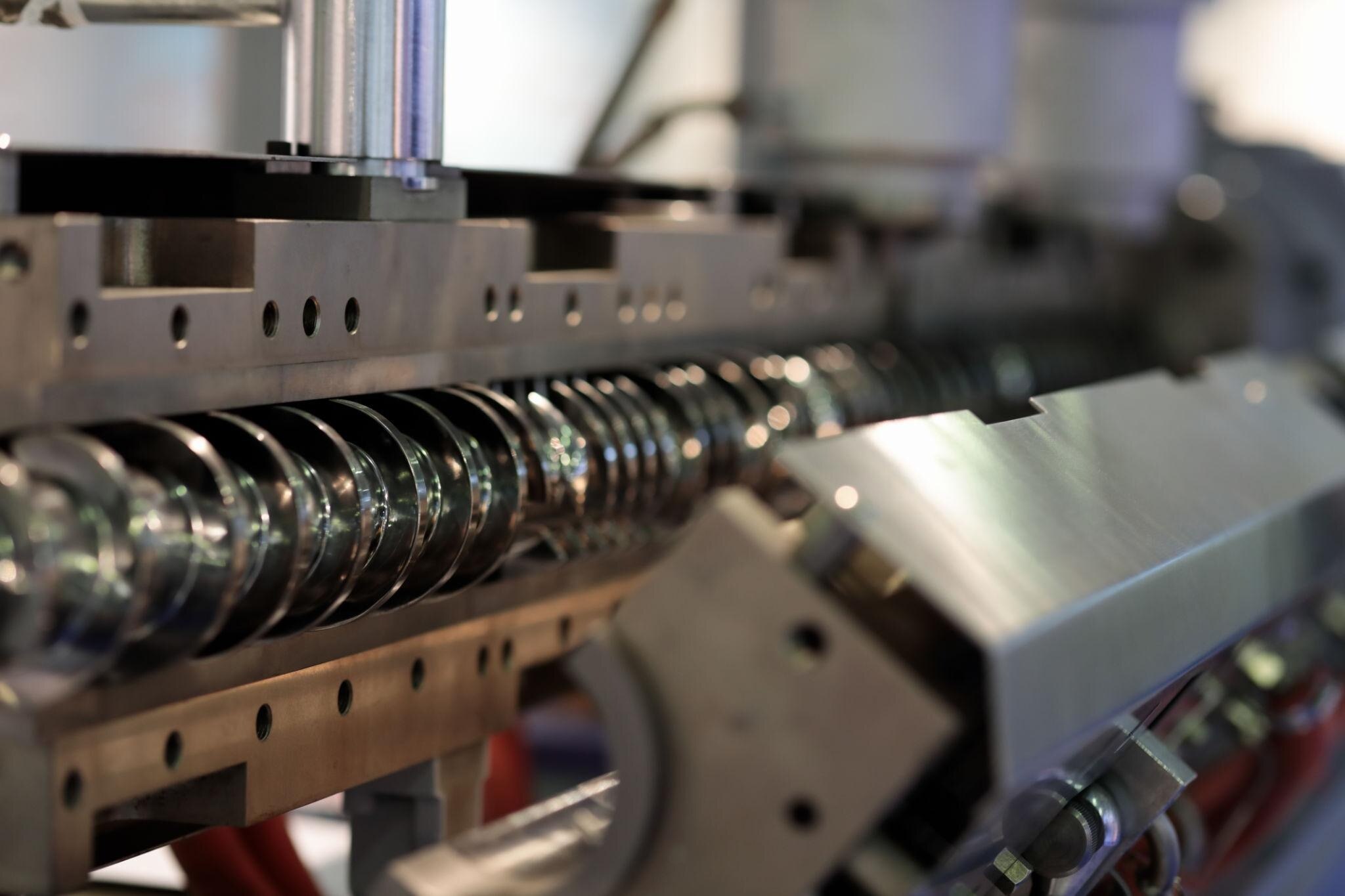
A screw barrel and a die pin sit in different parts of an extrusion line and solve different problems: one develops and delivers the melt, while the other shapes the product at the die. By comparing their positions, failure symptoms, material requirements and inspection methods, you can decide whether the job calls for a complete screw-barrel assembly, a die-pin replacement or a wider tooling correction.
Key takeaways
- Replace the die pin when the flow-forming insert is damaged but the screw and barrel remain sound.
- Choose a complete screw-barrel assembly when flight wear, poor output or excessive clearance affects the process.
- Match screw geometry, barrel alloy and die-pin design to the polymer and processing temperature.
- Measure wear, inspect surfaces and record polymer grade before ordering replacement extruder parts.
Screw barrel, die pin and extruder machine: which part controls what?
The extruder machine is the complete system, not one replaceable part. The screw rotates inside the barrel to convey, melt, mix and pressurize polymer. The barrel contains the melt, supports heating and cooling zones, and provides the clearance surface around the screw flights.
| Part | Location | Main control |
|---|---|---|
| Extruder machine | Complete line | Feeding, heating, conveying, pressure and product formation |
| Screw | Inside the barrel | Melting, mixing, pressure generation and melt delivery |
| Barrel | Around the screw | Melt containment, temperature control and flight clearance |
| Die assembly | Downstream of the barrel | Converts pressurized melt into the product profile |
| Die pin | Inside the die | Forms the internal surface of a hollow product and controls local flow |
The screw-barrel pair controls melting capacity, pressure generation and the quantity of melt reaching the die. The die and die pin control the final flow passage and local wall distribution, so an extruder machine screw barrel or die pin is not an interchangeable choice.
A die pin for plastic processing may mean a mandrel or core pin, but some suppliers use the term for one removable insert rather than the complete mandrel assembly. In pipe, tube, hose or hollow-profile extrusion, it forms the inside surface while the surrounding die forms the outside surface.
Before comparing quotations, request a drawing that identifies the die pin, die body, die land, centering hardware and melt channel. Confirm what the supplier means by “die pin” before comparing diameter, length or material grade.
When a die pin is a mandrel, core pin or separate die insert
A die pin for plastic processing is the internal tooling element that shapes a hollow product, but its name does not identify its exact form. Depending on the die design, it may be a complete mandrel, removable core pin, tip, sizing insert or another separate die component.
In pipe, tube and hose extrusion, the pin sets the internal flow boundary and the annular melt gap between itself and the outer die. The finished inside diameter and wall thickness also depend on pin centering, die-land geometry, melt swell, drawdown, haul-off speed and calibration; pin diameter is not automatically the finished inside diameter.
Wire and cable tooling requires a separate distinction:
- Pressure tooling forces polymer around the conductor inside the die.
- Tubing tooling forms a tube that is drawn over the conductor.
Selecting a pin only by nominal cable diameter can produce eccentric coating or incorrect insulation thickness.
Before ordering, ask whether “die pin” means the complete mandrel or a separate insert. Request:
- Product drawing showing the die body, pin, die land, melt channel and centering hardware
- Polymer, blend, filler and contamination profile
- Target inside and outside dimensions
- Die-land length, operating temperature and pressure
- Expected melt swell and calibration method
- Required surface finish, concentricity and replacement tolerances
- Inspection records and expected wear life
A quotation for an extruder screw barrel die pin package that lists only diameter, length and material grade does not establish interchangeability.
How to choose between a complete screw-barrel assembly and one die pin
Choose the complete screw-barrel pair when output is falling, pressure is unstable, melting is poor, motor load is rising, residence time varies or measured flight-to-barrel clearance has increased. Clearance lets melt leak over worn flights, reducing pumping efficiency.
Replacing only the screw against a worn barrel, or only the barrel around a worn screw, can leave the mating wear surface and fail to restore output.
Choose one die pin when the screw and barrel remain stable but inspection finds a pin that is bent, undersized, scored, corroded, misaligned or poorly centred. This is the practical extruder machine screw barrel or die pin decision; these are different extruder machine parts.
| Option | What it means | When it applies |
|---|---|---|
| Complete screw-barrel assembly | Matched conveying, melting and pressure-generating wear system | Process performance has deteriorated or clearance is excessive |
| One die pin | Replacement internal-forming component in the die | Pin geometry or condition is defective while screw-barrel performance is stable |
Before ordering, record:
- Polymer: PE, PP, PVC, PET or another resin; filler or glass-fibre content; recycled contamination; moisture and volatile load
- Melt-temperature range, throughput, screw diameter, L/D ratio, screw speed, die opening and exact product profile
- Screen-pack pressure, operating pressure, required wall thickness and calibration method
- Expected wear mechanism, required hardness or surface treatment, replacement tolerances and inspection records
Filled polymers and dirty recycled feedstock justify abrasion- or corrosion-resistant surfaces only when inspection supports that choice. In an extruder machine parts comparison, a quotation listing only diameter, length and generic alloy grade does not prove interchangeability.
Match screw geometry and barrel construction to the polymer
Diameter and alloy grade are insufficient for an extruder screw barrel die pin comparison: polymer behaviour depends on geometry, processing history and wear conditions. Check feed, transition and metering lengths, flight depth, compression ratio, L/D ratio, mixing elements, barrier flights, vent or vacuum sections, screw-speed range and intended polymer.
| Polymer or feedstock | Selection focus | Risk when mismatched |
|---|---|---|
| PE or PP | Balance solids conveying, melting and controlled mixing | Surging, incomplete melting or excessive shear |
| PVC | Tight temperature control, corrosion resistance and short residence time | Hydrogen chloride, corrosive deposits, black specks or unstable output |
| PET | Moisture control and controlled residence time | Bubbles, hydrolysis-related defects or degraded melt |
| Glass fibre, mineral filler, carbon black or dirty recycled feedstock | Abrasion resistance matched to actual loading | Rapid wear, feeding instability or unnecessary cost |
Recycled material varies in bulk density, moisture and contamination, so feeding can surge and produce bubbles, die drool or surface defects. A vented barrel or vacuum section removes volatiles only when the melt seal, vent design and vacuum system work correctly.
Screen packs and breaker plates filter contamination; they do not correct unsuitable screw geometry. Finer screens raise pressure and melt temperature while reducing throughput.
For an extruder machine parts comparison, give a manufacturer or component supplier the polymer, filler profile, contamination, throughput, temperature, pressure, screw speed, wear-life target and inspection data. Ashwini Engineering Works should receive those operating details rather than a request for a generic “high-quality” screw barrel or pin.
Diagnose barrel wear and die-pin defects before ordering
Separate screw-barrel wear from tooling defects by trending output, melt pressure, motor current, melt temperature and screw speed against a known-good production run. Falling output with higher motor load, poor melting, pressure fluctuation, streaks or longer residence-time effects points to the screw-barrel system, but confirm it after removing and cleaning the parts.
| Symptom pattern | Likely source | Confirmation |
|---|---|---|
| Falling output, rising motor load | Screw-barrel wear | Measure flight-to-barrel clearance and inspect flight crests |
| Uneven tube wall or eccentricity | Die-pin centering or flow imbalance | Check pin straightness, centering hardware and die-face parallelism |
| Melt leakage | Damaged mating faces or excessive clearance | Inspect contact surfaces after cleaning |
| Sharkskin, rough exit or die drool | Contamination, finish, shear or temperature | Check deposits, surface condition, throughput and melt temperature |
Measure screw-flight crest condition, barrel-bore condition and flight-to-barrel clearance at several axial and rotational positions with calibrated plant equipment. Compare every result with the equipment drawing or maintenance specification; do not invent a universal tolerance.
For a die pin for plastic processing, follow this inspection sequence:
- Stop, cool and isolate the die under the plant’s lockout procedure.
- Clean polymer deposits before inspection.
- Check the pin on a certified surface or between centers for straightness.
- Inspect the nose and die-land surfaces under magnification.
- Compare diameter and length with the drawing.
- Verify centering hardware, die-face cleanliness and parallelism during reassembly.
In an extruder machine parts comparison, polishing a pin will not cure melt fracture. Recheck alignment before changing haul-off speed or temperature.
Frequently asked questions
What controls conveying and melting in an extruder machine?
The screw conveys, melts, mixes and pressurizes polymer while rotating inside the barrel. The barrel contains the melt and provides heating, cooling and the clearance surface around the screw flights.
Is a die pin the same as a mandrel or core pin?
A die pin can act as a mandrel or core pin when it forms the inside of a hollow product. A separate die insert performs a similar flow-forming role only when the die design uses replaceable inserts.
When should you order a complete screw-barrel assembly?
Order the assembly when screw flights and barrel surfaces both show wear, when clearance has increased, or when output and mixing remain poor after process checks.
What should you check before ordering a die pin for plastic processing?
Check the polymer grade, melt temperature, product dimensions, die-pin material, surface condition, concentricity and the exact dimensions of the existing die assembly.